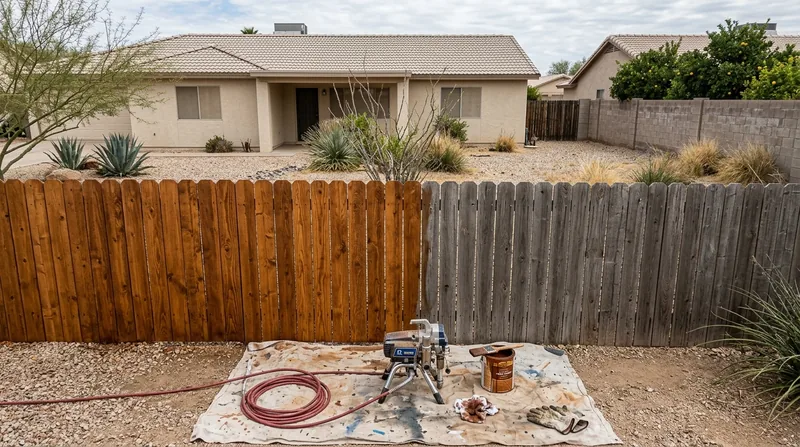




Mesa's desert climate demands a different approach to fence maintenance than humid regions. The relentless Arizona sun fades and degrades untreated wood far faster than rot ever would, and the caliche-based soil that makes post holes slow to dig also means your fence posts fail by splitting and loosening rather than rotting at the ground line. Fence staining in Mesa is not optional maintenance for cedar fences, side yards, and pool enclosures, it is the difference between a fence that lasts another decade and one that splinters into failure within five years. We clean, brighten, and seal cedar wood the right way, then tell you honestly when staining still makes sense and when the wood is past saving.
Why Fence Staining Matters in Mesa's Desert Heat
Mesa's intense UV exposure and low humidity create conditions that few homeowners in wetter climates ever face. Wood does not rot here, but it dries, checks, splinters, and loses all protective stain within four to six years of exposure. A cedar fence that you stain properly today can stay sound and attractive for 10 to 12 years. Without sealing, that same fence becomes gray, brittle, and unsafe in half that time. The economics are clear: a $950 stain job now costs far less than replacing 80 linear feet of fence.
- Sealed wood resists the sun's degradation and stays structurally sound longer than bare wood.
- Regular staining prevents deep checking and splintering that makes a fence dangerous to touch.
- A well-maintained fence holds its value and appearance through multiple Arizona summers.
- Staining is cheaper than replacement and keeps your fence in service for years more.
Mesa homeowners who invest in staining every four to five years protect their investment and avoid the shock of a full fence replacement.
Local reality: A cedar fence in Phoenix or Mesa that was installed in 2015 with no sealing is likely gray, checked, and losing pickets by 2024. The same fence, stained in 2018 and again in 2021, would still be solid and attractive today. That is the difference between ignoring UV and respecting it.
Learn more about the full lifecycle of wood fences at our wood privacy fence installation page, where we cover species selection and long-term durability.
How We Clean, Brighten, and Seal Your Fence
Fence staining done right is a three-step process: clean the wood to remove gray oxidation and surface dirt, apply a wood brightener to restore color and prepare the grain, then seal with a penetrating stain that soaks into the wood rather than sitting on top like paint. We work on cedar exclusively because it is the only species that responds well to this process in Mesa. Pressure-treated pine does not stain evenly and does not hold color. Vinyl and chain link do not need staining at all. The job takes one to two days for a typical side yard or pool enclosure, depending on linear footage and how much prep the wood needs.
- We inspect the fence and assess the wood condition, checking for rot, loose pickets, and structural damage that staining will not fix.
- We clean the fence with low-pressure water and a wood-safe detergent to remove gray oxidation, algae, and dirt buildup.
- We apply a wood brightener to lift the color and open the grain so stain penetrates evenly and deeply.
- We apply a penetrating wood stain in your choice of color, allowing it to soak in rather than dry on the surface.
- We inspect the final result and address any missed spots or uneven coverage before we leave the site.
The entire process restores the wood's natural beauty and locks in protection against UV, moisture, and splintering.
Real example: A 40-linear-foot cedar pool enclosure in Chandler that was installed in 2016 without staining had turned gray and was showing surface checks by 2023. We cleaned, brightened, and sealed it in one day. The wood is now warm honey-colored, tight, and safe to touch. The same fence will need staining again in 2027 or 2028, not replacement.
If your fence has structural damage or rotten posts, see our fence post repair page for repair and replacement options.
Staining Methods and Materials
| Approach | Description | Best For |
|---|---|---|
| Water-Based Penetrating Stain | Low-VOC formula that soaks into the wood grain and allows the natural color to show through. Dries fast and is easy to recoat. | Most Mesa cedar fences. Homeowners who want natural wood appearance and eco-friendly products. |
| Oil-Based Penetrating Stain | Traditional formula that penetrates deeply and offers longer color retention. Richer finish but slower drying and higher VOC. | Fences in shade or mixed sun/shade. Homeowners who prioritize durability and color depth over drying time. |
| Semi-Transparent Stain with UV Blockers | Blended formula that combines penetration with added UV protection. Shows wood grain while offering stronger sun defense. | Full-sun cedar fences in Mesa and Phoenix. Maximum protection against the Arizona sun. |
| Solid Color Stain (Opaque) | Paint-like coverage that masks the wood grain and provides the heaviest UV barrier. Requires more frequent recoating. | Fences with significant surface damage or color matching to trim. Homeowners who want bold, uniform color. |
We recommend water-based penetrating stain for most Mesa cedar fences because it balances durability, appearance, and environmental impact. The choice depends on your sun exposure, desired finish, and maintenance tolerance.
Fence Staining and Restoration Cost in Mesa: What to Expect
Fence staining starts at $950 for a small to medium cedar fence or gate enclosure, typically 30 to 50 linear feet. The price moves up based on linear footage, the condition of the wood (heavy oxidation and mold require more aggressive cleaning), and access. A full 80-linear-foot side yard runs $1,400 to $1,800. A pool enclosure with interior and exterior surfaces costs more per linear foot because both sides need cleaning and sealing. Getting two or three estimates is smart because prep work varies widely depending on how much gray oxidation and mold have built up over the years.
The cost also depends on whether the fence is structurally sound. If we find rotten posts, loose pickets, or split rails during inspection, those repairs are separate from staining. Staining seals wood that is already tight and sound. It does not fix structural damage. We tell you upfront if staining is the right choice or if repair or replacement makes more sense.
See our full pricing page for a detailed breakdown of costs by service and size.
Fence Staining and Restoration Near Me: What Mesa Homeowners Should Know When Hiring
Hiring a fence contractor for staining is straightforward if you know what to look for. Ask for insurance and workers' compensation coverage and request a certificate of insurance before work begins. In Arizona, fence installation and repair above $1,000 or whenever a permit is required must be performed by a contractor holding an Arizona Registrar of Contractors (ROC) license, classification R-14 Fencing. That law is set by the state and applies to all jurisdictions. Verify that your contractor holds that license if your job scope requires it. Get at least two estimates and ask each contractor how they handle prep, what stain they recommend for full sun, and how long they expect the seal to hold under Mesa conditions. Ask for references from recent jobs in your area. Check whether your HOA or city has rules about stain color or finish before you commit.
We are fully insured and hold an AFA Member Installer credential from the American Fence Association. We have been in business since 2015 and work across Mesa, Gilbert, Chandler, Scottsdale, and Phoenix. Call us at (623) 777-2021 for a free estimate and honest advice on whether your fence should be stained or repaired.
Ready to get started? Contact us for a free estimate or call to discuss your fence condition and staining options.
Fence Staining & Restoration in Mesa: Pricing Guide
| Service | Price | Details |
|---|---|---|
| Small cedar fence or gate enclosure | Starting at $950 | 30 to 50 linear feet, light to moderate oxidation, one day of work |
| Medium side yard or pool enclosure | Starting at $1,400 | 60 to 80 linear feet, moderate to heavy oxidation, mold or algae, one to two days |
| Large fence runs or multiple enclosures | Starting at $1,800 | 100+ linear feet, significant prep work, interior and exterior surfaces, two to three days |
| Structural repair before staining | On estimate | Rotten posts, loose pickets, or split rails must be repaired or replaced before staining |
| Travel and site visit | Included | No mileage fee or call-out charge in Mesa and surrounding Greater Phoenix service areas |
| Free estimate | Free | Response within 24 hours, no obligation to book, honest assessment of repair versus replacement |
Indicative pricing, the exact cost depends on square footage, finish, and site access. Free personalized estimate within 24h at (623) 777-2021.


