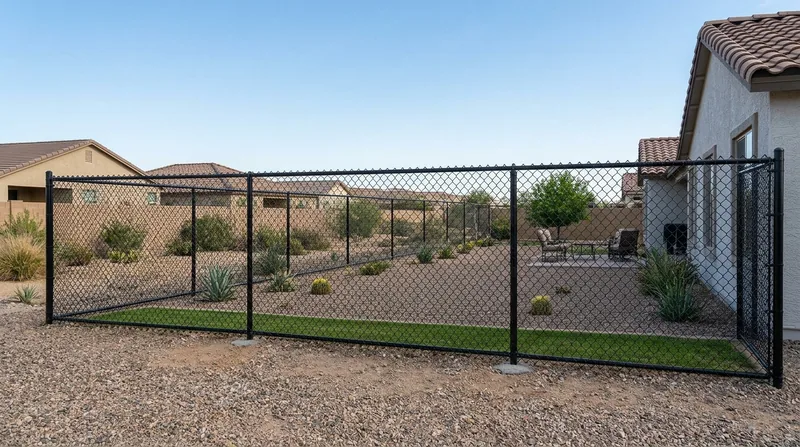




Chain link fence installation in Mesa is the practical choice for homeowners who need durability without the cost of wood or vinyl. Mesa's intense UV, caliche hardpan, and desert climate demand materials that resist fading and splitting rather than rot. Chain link delivers toughness per dollar, and when tensioned correctly with proper bracing, it outlasts neglect and weather that compromise other fencing. Whether you're enclosing a yard for pets, securing a commercial lot, or screening an RV pad, galvanized or black vinyl-coated mesh holds its line year after year in the Arizona heat. Mesa Fence Company has installed and repaired chain link fence since 2015 across Mesa, Gilbert, Chandler, and the surrounding Valley. We work from your property line, handle caliche drilling with the right equipment, and brace every corner so your fence doesn't sag or rack when the monsoon wind hits.
Why Chain Link Fencing Matters in Mesa's Desert Environment
Mesa's relentless sun and seasonal microbursts test fencing materials in ways that humidity never does in wetter climates. Wood splits and loosens as UV breaks down fibers and the ground shifts with temperature swings. Vinyl holds color longer than wood, but chain link requires no sealing, no staining, and no seasonal maintenance. The mesh is galvanized steel or vinyl-coated for corrosion resistance, and the frame is built to handle wind load without racking. When a monsoon dust storm flattens a poorly braced fence, chain link with corner bracing and proper tension springs back; a fence installed loose or without anti-sag bracing will belly and sag permanently.
- Galvanized steel mesh resists rust in Mesa's dry climate and costs less upfront than vinyl-coated options.
- Black vinyl-coated chain link hides dirt and maintains appearance longer under intense UV exposure.
- Posts set in concrete and spaced correctly (typically 6 feet) prevent racking and sagging even in high wind.
- Corner bracing and tension bands keep mesh tight and prevent the bellying that weakens fencing over time.
- Privacy slats and windscreen fabric can be added to block sightlines or reduce wind load without replacing the entire fence.
Proper installation in Mesa means drilling through caliche, setting posts deep enough to resist heaving, and bracing corners so your fence stands true through summer heat and monsoon season.
Local reality: Caliche hardpan beneath Mesa's surface requires a power auger or jackhammer to set posts efficiently. Shallow post holes or posts set only in tamped earth will heave and loosen as ground temperature cycles through 40-degree swings. Concrete-set posts and proper spacing are not optional in this soil.
For more information on fencing options and when repair makes sense before replacement, see our fence repair page.
How We Install Chain Link Fence in Mesa: Step-by-Step Process
Installation starts before the first post hole is dug. We locate your property line and verify any HOA or city setback rules that apply in your neighborhood. Arizona law requires an 811 utility locate call before digging anywhere on your property, and we file that call before work begins. Once utilities are marked, we assess the soil, plan post spacing, and determine whether standard tamping or concrete footings are needed based on soil condition and fence height. In Mesa, we almost always concrete-set posts because caliche and temperature swings demand it. The mesh is then stretched, tensioned with a stretcher bar and tension bands, and braced at corners to prevent sag.
- We call 811 for utility locate and mark the fence line with your input and any survey you have on file.
- Posts are set in concrete at the depth and spacing required for your fence height and local wind load.
- Mesh is unrolled, attached to the first post, and then stretched tight using a stretcher bar and power equipment.
- Tension bands secure the mesh to each post, and corner braces are installed to prevent racking and wind sag.
- Gate hinges and latches are installed if gates are part of your project, with self-closing hardware for pet containment.
The entire process typically takes one to three days depending on fence length, soil conditions, and whether gates are included. We clean up all debris and haul away any old fencing if you're replacing an existing line.
Example in Mesa: A 150-foot residential fence in a typical Mesa subdivision with caliche soil, two gates, and standard 4-foot height takes about two days. The first day is site prep, utility locate, and post holes. The second day is mesh installation, tensioning, corner bracing, and gate hardware. If the caliche is shallow or dense, we may need an extra crew member with a jackhammer or auger.
If you have an existing fence that needs repair rather than replacement, our post repair and replacement service can extend the life of your fence for years.
Chain Link Fence Installation Methods and Materials
| Approach | Description | Best for |
|---|---|---|
| Galvanized Steel Mesh | Hot-dip galvanized posts and 11-gauge or 9-gauge mesh, silver finish. No coating, lowest initial cost, withstands desert UV and dry air corrosion well. | Utility fencing, pet containment, commercial lots, budget-conscious homeowners in Mesa who accept a utilitarian appearance. |
| Black Vinyl-Coated Mesh | Galvanized frame with PVC-coated mesh and posts in black. Resists fading better than galvanized, hides dirt, maintains color through intense UV exposure, slightly higher cost than bare galvanized. | Residential yards, pet enclosures, RV screening, anywhere appearance and long-term color retention matter in Mesa's harsh sun. |
| Privacy Slats and Windscreen | Vinyl or mesh fabric woven into existing chain link mesh to block sightlines or reduce wind load. Installed on completed fence or added later without replacing mesh. | Homeowners who want privacy without the cost of a wood fence, or those reducing wind pressure on existing fencing before monsoon season. |
| Concrete-Set Posts with Corner Bracing | Posts set in concrete footings at least 24 to 30 inches deep, with anti-sag bracing at each corner. Prevents heaving in caliche and wind sag in desert conditions. | Standard in Mesa. Mandatory for any fence taller than 4 feet or in areas with frequent wind. Resists temperature cycling and ground movement. |
| Tension Bands and Stretcher Bar Installation | Mesh is pulled tight with a power stretcher and secured to posts with tension bands and bands that distribute load evenly. Prevents belly sag and maintains fence line integrity. | All residential and commercial chain link fencing in Mesa. Proper tensioning is the difference between a fence that holds for decades and one that sags within a few years. |
Chain Link Fence Installation Cost in Mesa: What to Expect
Chain link fence in Mesa typically runs starting at $16 per linear foot for galvanized steel mesh with concrete-set posts in standard residential conditions. That estimate covers posts, mesh, corner bracing, tension bands, and labor to install on level ground with accessible caliche. Several factors move the price up: if the ground is extremely dense caliche requiring jackhammer drilling, if the fence runs on a slope and requires stepped or racked installation, if gates are included, or if you choose black vinyl-coated mesh instead of galvanized. A 150-foot fence at the starting rate costs roughly $2,400 before any add-ons. If the job includes two gates, privacy slats on half the run, or heavy caliche drilling, the total can reach $3,500 to $4,500 depending on site conditions.
The best way to understand your actual cost is to get two or three estimates on-site. We offer free estimates with no obligation, and we respond within 24 hours. An on-site look lets us assess soil, measure the exact run, identify any obstacles, and quote the real cost for your property. Hidden costs do not appear later; what we quote is what you pay, plus any permit fees if the city or your HOA requires them.
For detailed pricing on all our services and to compare chain link against wood, vinyl, and ornamental options, visit our pricing page.
Choosing a Chain Link Fence Installer Near Me: What Mesa Homeowners Should Know
Hiring the right installer protects your investment and ensures the fence stands true for years in Mesa's climate. Start by verifying that the contractor carries general liability and workers' compensation insurance; ask for a certificate of insurance before work begins. In Arizona, fence installation is regulated trade: projects involving labor and materials over $1,000, or any project requiring a building permit, must be performed by a contractor holding an Arizona Registrar of Contractors (ROC) license in classification R-14 (Fencing). The law requires this license for metal, wood, and block fencing, and automatic gates. Always ask a contractor for their ROC number and verify it with the Arizona Registrar of Contractors; if they cannot provide one and your project scope exceeds $1,000 or requires a permit, walk away. Get at least two estimates so you can compare approach, materials, and price. Check references and ask about their experience with caliche and desert installation. Ask about warranty: most reputable shops stand behind their work for one year against defects in installation and materials.
- Verify the contractor holds an Arizona ROC license in the Fencing category (R-14) and ask for the license number.
- Request proof of general liability and workers' compensation insurance, and ask for a certificate of insurance on file.
- Ask whether the contractor calls 811 for utility locate before digging and whether they set posts in concrete or only tamp soil.
- Confirm that corner bracing and tension bands are included in the estimate, not added as surprises later.
- Clarify whether the estimate includes removal of old fencing, permits, and haul-away, or if those are separate line items.
- Ask about HOA approval: if your neighborhood has deed restrictions, the contractor should help you understand what materials and colors are allowed.
Mesa Fence Company holds an AFA Member Installer credential and is fully insured with general liability and workers' compensation. We have been installing and repairing fencing since 2015. Call us at (623) 777-2021 for a free estimate and to discuss your project, or visit our contact page to request an estimate online.
Chain Link Fence Installation in Mesa: Pricing Guide
| Service | Price | Details |
|---|---|---|
| Galvanized Steel Chain Link Fence | Starting at $16/ft | Posts set in concrete, 11-gauge or 9-gauge mesh, corner bracing, tension bands included. Price varies with soil type and caliche drilling difficulty. |
| Black Vinyl-Coated Chain Link Fence | Starting at $22/ft | Galvanized frame with black PVC-coated mesh and posts. Better UV and color retention than bare galvanized, ideal for residential lots and pet enclosures. |
| Privacy Slats or Windscreen Fabric | Starting at $4/ft | Added to existing chain link mesh to block sightlines or reduce wind load. Can be installed on new fence or retrofitted to existing runs. |
| Gates and Hardware | Starting at $300 | Single-swing gate with self-closing latch, hinges, and hardware. Double gates and automatic operators priced separately on estimate. |
| Caliche Drilling and Soil Prep | Included | Standard post-hole drilling through desert caliche with power auger or jackhammer as needed. No separate charge for typical residential soil conditions. |
| Free Estimate | Free | On-site assessment, utility locate coordination, and detailed quote. Response within 24 hours at (623) 777-2021. No obligation to book. |
Indicative pricing, the exact cost depends on square footage, finish, and site access. Free personalized estimate within 24h at (623) 777-2021.


