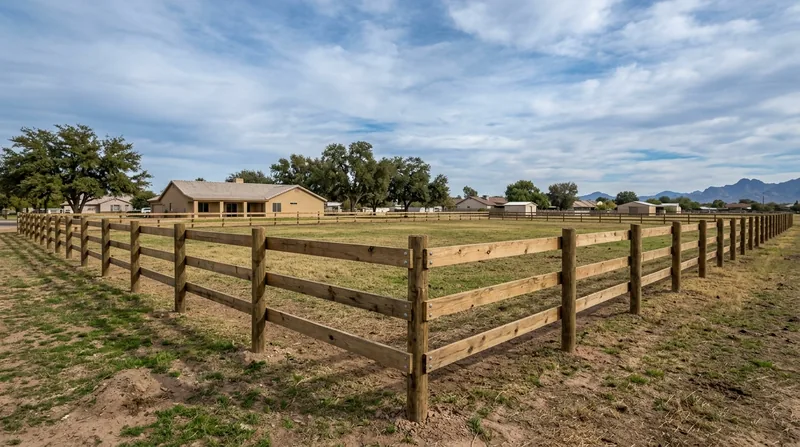




Farm fence installation in Mesa serves a growing number of acreage owners and small-scale ranchers across the greater Phoenix area who need durable perimeter fencing built to hold livestock, define property lines, and withstand the relentless desert sun. Unlike the block walls that dominate residential Mesa, ranch and farm fencing demands a different approach: longer runs, heavier bracing, larger gate openings, and materials chosen for their ability to survive intense UV exposure and the cemented caliche soil that makes post holes a genuine undertaking. Whether you're installing no-climb horse fence, split rail for cattle, pipe fencing for equipment containment, or field wire for mixed grazing, the work requires understanding local soil conditions, wind loads from monsoon season microbursts, and the specific codes that apply to your property type and location within Greater Mesa.
Why Farm & Ranch Fencing Matters in Mesa's Desert Climate
Acreage owners in and around Mesa face a unique set of challenges when it comes to perimeter fencing. The intense UV radiation here degrades untreated wood and fades powder coating faster than humidity ever rots fence materials in wetter climates. Posts fail by splitting and loosening rather than rotting at the ground line, which means the fence line must be set deep in concrete and braced against wind and animal pressure. A properly installed ranch fence on Mesa acreage can last 15 to 20 years with maintenance; a poorly installed one may need repairs within five.
- Posts set in concrete resist the loosening that comes from freeze-thaw cycles and from animal pressure, and they hold their alignment year-round in the Arizona desert.
- Braced corners and anti-sag bracing on long runs prevent the fence from racking (twisting) when monsoon microbursts hit, which they do regularly from June through September.
- Proper post spacing (typically 6 to 8 feet for ranch rail and no-climb horse fence) distributes weight and wind load evenly across the fence line.
- Galvanized or powder-coated hardware resists rust better than bare steel in the dry climate, but powder coating still fades and requires attention to gate hinges and latches.
- Field wire and pipe fencing for equipment or mixed grazing must be tensioned correctly to prevent sagging and to keep livestock from pushing through or under the line.
These details separate a fence that holds for decades from one that becomes a maintenance headache within a few seasons.
Local example: A 5-acre property near Apache Junction with sandy soil over caliche required 150 linear feet of no-climb horse fence. Caliche extended 18 inches deep, which meant auger work for each post hole. Concrete-set posts, galvanized hardware, and anti-sag bracing cost more upfront but eliminated post wobble and kept the fence straight through two monsoon seasons. Repair costs dropped to zero in year one.
For detailed guidance on what ranch fencing means in your jurisdiction, check with your local building department or county planning office. In Mesa, the city's development services department oversees fence height, setback, and material rules, and these vary across the greater Phoenix area. Visit the City of Mesa Development Services for permit requirements on your specific property.
How We Install Farm & Ranch Fencing in Mesa: Step-by-Step Process
Ranch fencing on acreage demands a methodical approach. We start with a site visit to assess soil type, existing utilities, terrain slope, and wind exposure. We then call 811 for a utility locate (required by Arizona law before any digging), mark the fence line with the property owner, and plan post spacing and bracing strategy. The actual installation follows a proven sequence that accounts for Mesa's caliche and monsoon wind loads.
- We locate and mark the fence line based on your survey or property markers, and we confirm no utilities run through the planned post holes by requesting a free 811 locate call.
- We dig post holes to the proper depth (typically 30 to 36 inches for ranch fencing) using auger equipment when caliche is present, and we set each post in concrete for permanence.
- We install stringers (horizontal rails) and attach pickets or wire, maintaining consistent spacing and ensuring the fence line is level or properly stepped on sloped terrain.
- We brace corners with diagonal bracing or anti-sag hardware to resist wind loads and prevent racking, which is critical in Mesa's monsoon season.
- We install and hang gates (ranch gates are typically wider than residential gates to accommodate trailers and equipment), ensuring self-closing or self-latching hardware where needed.
- We inspect the entire run for plumb, spacing, and hardware tightness before we consider the job complete.
The whole process respects the local terrain and the specific demands of ranch work in the desert.
Concrete example: A 10-acre property in Queen Creek with mixed grazing required 400 linear feet of split rail fencing for horses and 200 linear feet of field wire for cattle. Post spacing was set at 8 feet for the split rail and 6 feet for the wire. Anti-sag bracing was installed on the long north-facing run to handle wind. Total timeline was 8 working days, including the 811 locate wait and concrete cure time. The fence held straight through the following monsoon season without adjustment.
For more information on gate installation and sizing for ranch work, see our gate installation and repair page.
Farm & Ranch Fencing Methods and Materials
| Approach | Description | Best for |
|---|---|---|
| Split Rail Fencing | Horizontal rails (typically 2x6 or 2x8 cedar or pressure-treated pine) mortised into posts set in concrete. Classic appearance, open sight lines, moderate maintenance. | Horses, cattle, visual property definition on acreage where aesthetics matter. |
| No-Climb Horse Fence | Vinyl-coated wire mesh (typically 1.5 inch or 2 inch square openings) stapled or clipped to wooden posts and rails. Prevents horses from climbing or catching hooves. Very durable in desert UV. | Horse pastures and small paddocks where safety and durability are priorities. |
| Pipe Fencing | Steel or aluminum pipe (typically 1.5 to 2 inch diameter) welded or bolted to posts. High strength, minimal maintenance, industrial appearance. Galvanized or powder-coated for rust resistance. | Equipment containment, round pens, arena perimeters, heavy-use areas where wood would splinter or fail. |
| Field Wire Fencing | Woven or welded wire mesh (various gauges and mesh sizes) tensioned between posts using stretcher bars and tension bands. Affordable, functional, requires periodic re-tensioning. | Large pastures, mixed grazing, perimeter security on acreage, containment of smaller livestock. |
| Barbed Wire Fencing | High-tensile barbed wire strung between posts and secured with staples or clips. Low cost, minimal visual impact, requires strong posts and regular tensioning. | Cattle ranches, perimeter security on large acreage, supplementary fencing with other materials. |
Farm & Ranch Fencing Cost in Mesa: What to Expect
Ranch and farm fencing costs vary widely depending on the material, the fence line length, soil conditions, and the complexity of the terrain. Starting at around $12 per linear foot for basic field wire or split rail on level ground with easy digging, costs can climb to $25 to $35 per linear foot for no-climb horse fence with heavy bracing, or $30 to $50 per linear foot for pipe fencing. The biggest variables are caliche depth (which requires auger or jackhammer work and adds labor), post spacing and bracing strategy (longer runs with wind exposure demand more bracing), gate size and quantity, and the total linear footage.
A typical 5-acre property with 400 linear feet of no-climb horse fence on level ground with moderate caliche might run $8,000 to $12,000 installed. The same property with 600 linear feet of split rail plus two large gates could run $12,000 to $18,000. A 10-acre ranch with mixed fencing (split rail for horses, field wire for cattle, and heavy bracing for wind) can easily exceed $25,000. The only way to know your specific cost is to get an on-site estimate.
We recommend getting 2 to 3 estimates before you commit. Different contractors may propose different post spacing, bracing strategies, or material grades, and those choices affect both the price and the longevity of the fence. Visit our pricing page for more detail on how we structure estimates, or call us at (623) 777-2021 for a free, no-obligation assessment of your acreage.
Farm & Ranch Fencing Near Me: What Mesa Homeowners and Acreage Owners Should Know Before Hiring
Hiring the right contractor for ranch fencing on acreage is as important as choosing the right material. You need someone who understands desert soil, wind loads, and the specific codes that apply to your property. Before you sign a contract, verify that the contractor carries general liability and workers compensation insurance (ask for a certificate of insurance), understand how fence licensing works in Arizona, check references from recent ranch or acreage projects, and confirm that permits are obtained if your jurisdiction requires them.
Arizona law requires a Registrar of Contractors (ROC) license for fence work once labor and materials exceed $1,000, or whenever a building permit is required. The license classification is R-14 Fencing, which covers wood, metal, and block fencing, automatic gates, and cattle guards. Not all contractors hold this license, and not all jurisdictions within Greater Mesa enforce it equally. Ask your contractor directly, and verify the license number with the Arizona Registrar of Contractors if you want confirmation. Your local building department can tell you whether a permit is required for your specific project and location.
Deed restrictions and HOA architectural standards frequently govern fence height, material, and color in master-planned communities across Mesa, Gilbert, Chandler, and Scottsdale. Check your property deed and HOA rules before you design the fence. If your property is in an HOA, submit your plan for approval before work begins. Corner visibility and setback rules are set by the city or county and vary across the greater Phoenix area, so confirm those with the local building department as well.
- Verify that the contractor carries general liability and workers compensation insurance and can provide a certificate on request.
- Confirm that a free 811 utility locate will be called before any post holes are dug, as Arizona law requires it.
- Ask for references from recent ranch, acreage, or farm fencing projects in your area, and check at least two.
- Understand whether a building permit is required for your property and location, and confirm the contractor will obtain it if needed.
- Check your property deed and HOA rules for fence height, material, color, and setback restrictions before you design the fence.
- Get the estimate in writing with a detailed scope (material type, post spacing, gate size, bracing strategy) so you can compare apples to apples across contractors.
These steps protect you and ensure the fence is built to code and to last.
Ready to get started? Contact us at our contact page or call (623) 777-2021 for a free estimate. We are a Mesa-based AFA Member Installer and have been in business since 2015. We serve Mesa, Gilbert, Chandler, Tempe, Scottsdale, Phoenix, Apache Junction, Queen Creek, and surrounding areas.
Farm & Ranch Fencing in Mesa: Pricing Guide
| Service | Price | Details |
|---|---|---|
| Split Rail Fencing | Starting at $12/ft | Cedar or pressure-treated rails mortised into concrete-set posts, level terrain, moderate caliche digging |
| No-Climb Horse Fence | Starting at $18/ft | Vinyl-coated wire mesh, wooden posts, anti-sag bracing, includes labor and hardware for secure installation |
| Pipe Fencing | Starting at $25/ft | Steel or aluminum pipe, galvanized or powder-coated, welded or bolted assembly, minimal maintenance material |
| Field Wire and Barbed Wire | Starting at $8/ft | Woven or welded mesh, stretcher bars and tension bands, periodic re-tensioning required, cost varies by gauge and mesh size |
| Complex or large acreage jobs | On estimate | Caliche auger work, extensive bracing, multiple gates, terrain slope, and specialized equipment affect final price |
| Estimate and travel | Free | No obligation, response within 24 hours, travel included in Mesa and surrounding counties, call (623) 777-2021 |
Indicative pricing, the exact cost depends on square footage, finish, and site access. Free personalized estimate within 24h at (623) 777-2021.


